
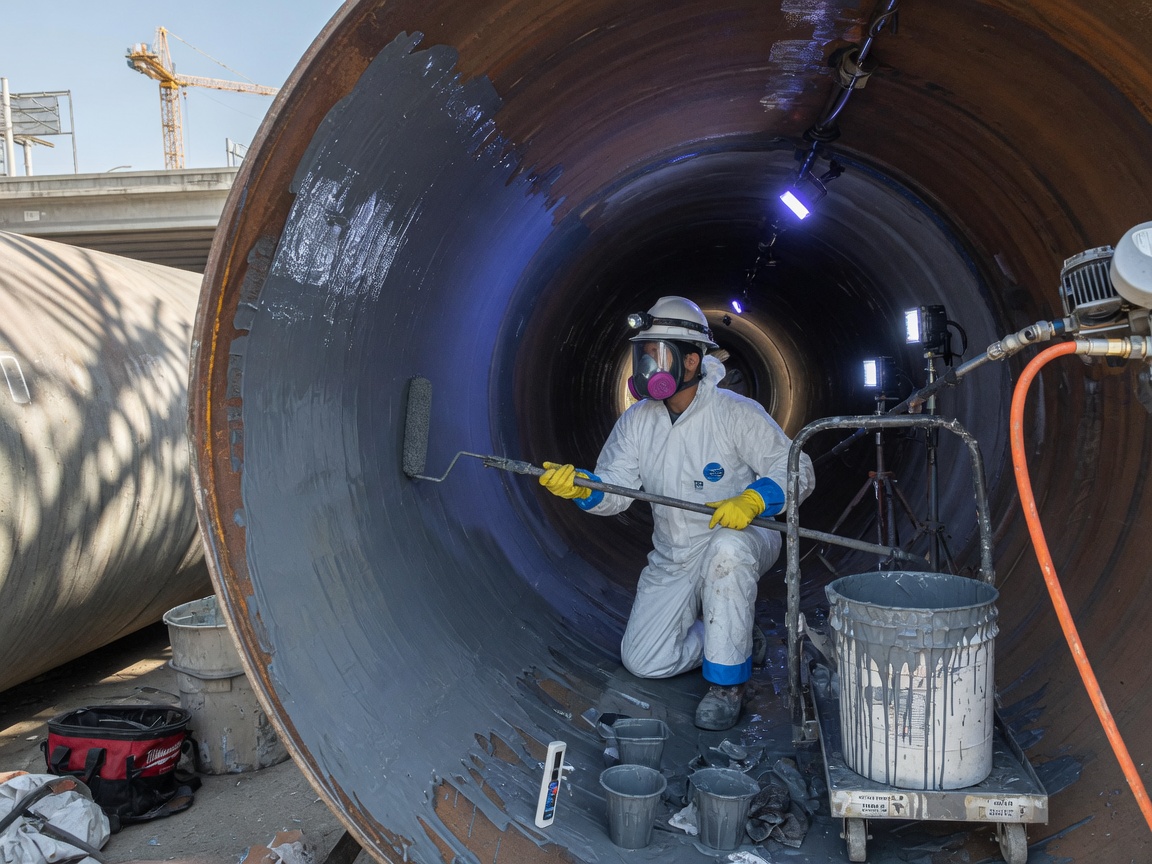
Los Angeles homes built before 1960 often have cast iron or clay sewer laterals that corrode from decades of root intrusion and mineral buildup. Epoxy pipe coating creates a smooth, jointless barrier inside the existing pipe after hydro-jetting removes scale and debris. In neighborhoods like Silver Lake and Echo Park, where hillside lots create steep pipe runs, the coating must be applied in controlled passes to avoid thin spots at bends. The county’s Mediterranean climate means work windows stay open most of the year, though summer heat accelerates curing and requires careful temperature monitoring inside the pipe.
Technicians pull a calibrated epoxy mixture through the line using a pig or bladder system, then allow it to cure while monitoring flow and thickness with CCTV. This method works well in dense areas such as Koreatown and Boyle Heights where digging would disrupt traffic and utilities. Edge cases include pipes with multiple 45-degree offsets or previous partial repairs; these require pre-coating camera mapping to prevent voids. Los Angeles building codes require that any coating project on laterals serving more than one unit be documented and left accessible for future inspections.
Homeowners in Santa Monica and Westwood frequently request epoxy coating after repeated hydro-jetting fails to stop recurring backups. The process avoids the street cuts common with traditional replacement, preserving mature landscaping and hardscape around Griffith Observatory-area properties. Proper surface prep remains the critical factor; any residual grease or standing water will delaminate the epoxy within months. Crews therefore run a final vacuum and dry-air purge before introducing the resin.
Technician insight
In Los Angeles, the thing that catches most people out with Epoxy Pipe Coating is the fine clay and silt that settles in low spots after winter rains in places like Boyle Heights; if crews skip the final vacuum step the epoxy won’t bond and you’ll be back in six months.
Epoxy Coating on a 1950s Lateral in Silver Lake
A homeowner reported slow drains and occasional backups after heavy rain. Camera inspection showed root intrusion and scale in a 4-inch cast iron line running under the driveway. After hydro-jetting and drying, epoxy was applied in two passes to handle the 22-foot run with one 45-degree offset. The line tested clear and has remained free-flowing through the following dry season.
Epoxy Pipe Coating Services We Offer
✓Epoxy Coating for Cast Iron Sewer Lines
Restores corroded cast iron laterals common in pre-1960 Hollywood and Echo Park homes by forming a new interior pipe wall without excavation.
✓Residential Epoxy Pipe Lining
Applies food-grade epoxy to kitchen and bathroom drain stacks in single-family homes across Silver Lake and East Los Angeles to stop pinhole leaks.
✓Commercial Epoxy Pipe Coating
Lines larger-diameter lines in multi-unit buildings in Koreatown and Downtown Los Angeles where tenant disruption must stay minimal.
✓Trenchless Epoxy Restoration for Root-Damaged Pipes
Coats pipes infiltrated by tree roots near Santa Monica and Venice properties after mechanical root cutting and jetting.
✓Epoxy Coating for Offset or Bellied Lines
Addresses minor settlement in older Westwood and Pasadena laterals by smoothing interior transitions before the epoxy sets.
How it works
- 1
Camera Inspection and Mapping
Technicians run a CCTV camera from the cleanout through the line to document length, offsets, and any active leaks before any coating begins.
- 2
Hydro-Jetting and Surface Prep
High-pressure water removes scale, grease, and roots, followed by a dry-air purge to ensure the pipe wall is clean and dry for epoxy adhesion.
- 3
Epoxy Application
A measured epoxy mixture is pulled or sprayed through the pipe at controlled speed and pressure to achieve uniform wall thickness.
- 4
Curing and Final Verification
The coating cures while flow is monitored; a final camera pass confirms complete coverage and smooth interior before the line is returned to service.
Pricing
Cost depends on pipe diameter, total footage, and number of access points required in older Los Angeles housing stock.